Full-day kindergarten: beyond test scores

The Globe and Mail
Thu Apr 3 2014
Byline: Erin Anderssen
eanderssen@globeandmail.com

There are a lot of people disappointed with the results of Ontario’s full- day kindergarten program. According to a just-published study that compared the students in the first three years of the program, it hasn’t translated so far into better scores in reading or math at the end of Grade 1. The kids aren’t doing worse, but academic benefits are what everyone has focused on, because that’s largely how the $5-billion-a-year program was sold by the Liberal government. (Even the author of the study, Janette Pelletier, a child development expert at Ontario Institute for Studies in Education, says that the “fade-out” early learning measurements was a surprise.) Critics who call it “expensive babysitting” and think little kids should be at home more (a tricky feat when so many of their parents are working), are full of “I told you so’s.”

But hold on. It’s true that full-day kindergarten has not – at least not yet, anyway – transformed the province’s youngest scholars when it comes to early reading and writing scores, as a story by my colleague Caroline Alphonso pointed out last week. But the study suggested that kids maintained an advantage in other social and cognitive areas essential for school success. Their parents were also less stressed, and, in surveys, reported improvements in their kids on nearly every early learning measurement. All of which raise some important questions about the program that go beyond test scores:

1. Isn’t reducing family stress a legitimate reason for a social program?

The study conducted a “parental hassle survey” and found that parents were significantly “less hassled” if their kids were in full-day-kindergarten – which will comes as no surprise to any family that has tried to juggle half-day school with full-time work. Household stress also has a negative effect on long- term student achievement – to say nothing of the health of families in general, and the benefit that comes from facilitating work, especially for low-income parents and single moms, who have struggled most with child-care costs and logistics. What’s more, parents are happy with the program and report seeing a benefit in their children. Why aren’t these results seen as equally valuable to, say, boosting results on standardized tests?

2. What is happening in Grade One?

By almost every social and cognitive measure, the full-day kids had an edge over their half-day peers going into Grade One – but lost that advantage by the end of the year. Researchers are not yet sure why this is but some suggest that the more formal teaching structure in first grade may not be capitalizing on the benefits of play-based learning – something many educators hope will change over time.

3. What measurements really matter for future academic success?

Students in full-day kindergarten significantly outscored their half-day peers in two important areas: vocabulary and self regulation, which includes the ability to focus, follow instructions and co-operate with peers. Those gains held up through Grade 1, and, some research suggests, in the long run have a larger effect on adult outcomes. (Another plus: The more kids who arrive to class with these skills, the better the learning environment is for everyone. )

4. Now that we have a benchmark, how can we improve the program?

It’s hardly realistic to expect an education change requiring a huge cultural and curriculum shift for teachers, and major school reorganization, to transform student outcomes from day one. “It would be naive to expect a new approach to work on every dimension right away, and there is always room for improvement,” says Pelletier. What’s clear in the study is that some significant kinks still need to be worked out. In particularly, some classrooms have too many students.

There’s a shortage of early childhood educators, which means, according to Kerry McCuaig, an early childhood researcher also at OISE, that sometimes principals have to pitch in to cover absences. Co-operation between teachers and the ECEs now sharing their classrooms continues to be an issue. These are problems, however, that will take time to fix.

Even so, we would be wrong to expect that full-day kindergarten will fix all problems for every child, and perhaps both experts and politicians should have been more cautious about overselling it, especially at the beginning. A universal system offered to all families will not produce the same results as the targeted, specially designed interventions for disadvantaged children often cited in U.S. studies. Sweden took decades to create a preschool system that earns praises around the world (hopefully, we can learn from them and go faster). Given the size of the investment, we need to ask critical questions about the program without making hasty leaps. Ideally, ongoing research will reveal how we can make improvements, not just to the kindergarten program, but the next grades as well. For now, at least one group appears happy to reward the program an A-plus: the families actually using it.

(c) 2014 The Globe and Mail Inc. All Rights Reserved.

Tim Hudak accuses Liberals of letting ‘union bosses’ run education system

Saturday, April 19, 2014        News / Queen’s Park

Tim Hudak accuses Liberals of letting ‘union bosses’ run education system

Tory Leader Tim Hudak accuses Premier Kathleen Wynne of being too close to union bosses, says his government would bring in laws to put teachers in their place.

Tory Leader Tim Hudak and Progressive Conservative education critic MPP Lisa MacLeod spoke to reporters  at Queen's Park<br />

Richard Brennan / Toronto Star      Tory Leader Tim Hudak and Progressive Conservative education critic MPP Lisa MacLeod spoke to reporters  at Queen’s Park

By:  Provincial Politics,
Published on Wed Feb 27 2013
Tory Leader Tim Hudak says a Progressive Conservative government would not cosy up to teachers and their “union bosses” but rather would put them in their place.

“The teacher unions are not there to run the education system,” Hudak told reporters at Queen’s Park Wednesday.

Education Minister Liz Sandals made light of the “hysterical reaction” to teachers.

“They see a teacher and they see a union boss, some sort of hysterical reaction . . . (where) we have had really positive conversations with the teachers’ leadership,” she said later.

Still stinging from losing a motion in the legislature Tuesday that would have imposed additional work on teachers, Hudak scolded the Liberals and the New Democrats for siding with teachers in opposing the motion rather than parents and students.

“We owe it to students and parents to raise the bar . . . but we’re not going to do that by handing the keys to power over to the union bosses in our education system,” Hudak said.

“Last night’s debate shows that Premier (Kathleen) Wynne and the Liberals are again taking their marching orders from the teacher union bosses,” he said. “Quite frankly they’ve got no better friend in the premier’s chair, there is nobody closer to the teacher union bosses than Kathleen Wynne.”

Wynne and Sandals have said the Tories are only interested in creating chaos in the education system.

“I have no idea why Tim Hudak and Lisa Macleod want to make this into a negative story,” said Wynne with respect to the resumption extracurricular activities in the public high schools.

The motion introduced by Tory MPP and education critic Lisa MacLeod would have redefined the role of teachers by forcing them to perform certain duties, such as attending parent-teacher interviews, completing report cards and helping students with extra work after school hours. It addition it would prevent union leaders from threatening members with fines and embarrassment if they don’t follow union directives.

Teachers now are not required to participate in after-school parent-teacher interviews and are required to fill out report cards only to the best of their ability, which during the recent labour strife over extracurricular activities often resulted in one-line answers.

“Parents should have a right to a parent-teacher interview after three o’clock outside school hours. Two, it is dead wrong for the teachers unions to be able to able to bully classroom teachers with threats of $500 fines if they stay after school to help the kids . . . coach the football team or do the drama club,” Hudak said.

Hudak said a Tory government would take much of what was in the motion and put it into legislation, even though he suspects there would be serious push back from the teachers, reminiscent of the bitter disputes between the former Harris Progressive Conservative government and teacher unions in the late 1990s.

“We stand with classroom teachers, we stand with parents, we stand with taxpayers. That’s the big difference between us and the other two parties,” he said. “I expect the unions to always fight any chances they are going to lose power in the system.”

NDP Leader Andrea Horwath said Hudak’s idea of putting out a fire is to throw gasoline on it.

“You can’t solve a problem by throwing gas on it,” she said.

Hudak said fundamental changes have to be made to the law governing teachers “so this doesn’t keep happening over and over again. They have a right to strike but they don’t have a right to hold hostage students and parents in these work-to-rule actions. There is nothing extra about extracurriculars.”

The Ontario Secondary School Teachers Federation (OSSTF) and Elementary Teachers’ Federation of Ontario (ETFO) withdrew from extracurricular activities earlier this year when the Liberal government imposed contracts on the public elementary and high school teachers that froze their wages for two years and took away paid sick days, among other things.

The OSSTF just last Friday agreed to a deal with the government that it restart extracurricular activities, leaving ETFO the lone holdout.

 The Grants for Student Needs (GSN) Has Been Released

Have you ever wondered how the ALCDSB is allocated funds? Every year the Ministry of Education puts out the GSN, Grants for Student Needs report.  In an email from Paul O’Donnell he states that:

The main “B” memo is not posted on the ministry website yet–interested parties can keep a watch here:

http://faab.edu.gov.on.ca/B_Memos_2014.htm

But some useful documents have been posted on the ministry funding page:

http://www.edu.gov.on.ca/eng/policyfunding/funding.html

You can see your board’s total allocation, including a breakdown for each major grant in the GSN, in this document: School Board Funding Projections for the 2014-15 School Year, available here:

http://www.edu.gov.on.ca/eng/funding/1415/funding15.pdf

There is also a report on the ministry’s School Board Efficiencies and Modernization consultations.  The report includes CUPE’s recommendation that boards might save money by having custodial staff do simple preventative maintenance.  It also explores savings that might be achieved by combining “back office” functions (which we did not recommend!), and goes so far as to say “a joint human resources/legal team might be more cost-effective for managing collective agreements.”  However, the paper has no specific recommendations on back office savings.

The ministry is acting on the report’s recommendation to promote more efficient use of school space, by: reducing top up funding for schools with low enrolment; increasing funding for combining elementary and secondary schools in one building; providing new capital funding as an incentive to consolidate schools; providing funding to increase boards’ capacity to plan for more efficient use of their schools.

There is a report of the School Board Administration And Governance Grant Advisory Group that makes several recommendations on changing how money to support board admin and governance is allocated.  None of the recommendations appear to impact our members who provide IT, secretarial, clerical and other board office support.

http://www.edu.gov.on.ca/eng/funding/1415/BAAG_Report.pdf

The ministry is promising a new board admin and governance funding model will be unveiled that will be revenue neutral across the province, but which will result in some board allocations going up and others down.  The impact of the changes are being phased in over 4 years.

Special education funding is being changed, and there is a paper explaining the changes.  It is long and tortuous, but the essence is the ministry is finally moving away from funding the High Needs Amount using historical claims and moving towards using more recent data.  Like the board administration funding, change is projected to be revenue neutral across the province but will have an impact on individual boards, and thus the change is being phased in over 4 years.

http://www.edu.gov.on.ca/eng/funding/1415/2014_15SB04.pdf

And lastly the webcast briefing (for school board officials) has just been posted, which I really should read before saying much more about the GSN.  There will be more to come from me tomorrow.  But I should flag for you that the ministry is taking the position that the 97 day delay in grid movement will be caught under the statutory freeze provision of the labour relations act (OLRA), and if no new agreements are reached by Sept 1, grid movement will be delayed.  Thus the GSN provides no funding for grid movement.  It is a curious approach for the government to take: wouldn’t it be more prudent for it to assume that agreements will be reached before Sept. 1 and that the settlements will revert back to grid movement occurring when the collective agreements specify?

http://www.edu.gov.on.ca/eng/funding/1415/webcast2014.pdf


It will be interesting to see now that the allocation of funds has been announced how our school board’s support staff will be effected.  With a change to the funding model for Special Education it will be interesting to see if EAs will see a positive or negative result. Another interesting observation will be to see if the ALCDSB will take advantage of the incentive to combine grade 7 and 8 into high schools as they have done with St. Paul’s Catholic School in Trenton.

The link below will take you the 2014/2015 school Year Education Funding Memo that was sent to all Directors and Trustees in the province.  It breaks it down per board where money is being allocated.

b5 epo

OSBCC Conference

Eight members from CUPE 1479 Executive and Negotiation Committee spent four days at the OSBCC School Sector Conference in Niagara Falls from February 4-8, 2014.  There were many issues discussed during the event. Some of the areas covered were an update for Negotiation issues with Bill 122,  Secretary Report, Health and Safety Report, motions for the Provincial Bargaining Table, WSIB, Work Place Violence, unresolved issues with Bill 115, a protest rally at Niagara Catholic School Board, plus much, much more.  If you are interested in a copy of any information that we received please email lizjamescupe1479@gmail.com and I will forward it to you or send a hard copy to your school.

image_2

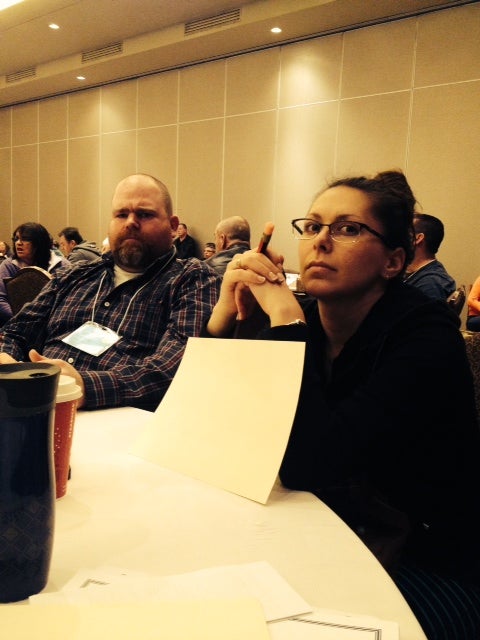
Kevin French, President and Jennifer Connor, VP West are taking a break to answer member emails and texts during the Area 5&6 Break Out Sessions.  This was a very useful session that allowed our Local and surrounding geographic Locals to discuss common issues and come up with some solutions.

image_4

Jody Uddenburg, ECE East Stewart and Paul O’Connor, Secretarial and IT Steward – West and Negotiation Committee with their VOTE cards during the Motion Business Section of our day.

image_6

Ted Grimson, Negotiation Committee Custodial- West in the mail conference room during.

image_7


Letter to Premier Wynne
Dear Sisters and Brothers:
Did you know that your local is one of the locals where the employer is defaulting to 66.66% pay on the 12th day of absence? Please complete and send the letter found in one of the links below. We are asking Premier Wynne to directly intervene in fixing this problem.
 English: http://osbcc.cupevotes.ca/
 French: http://cccso.cupevotes.ca/

Bill 122

All memebers are encouraged to look up Bill 122 on the internet.

CUPE Ontario News Update

Nov-Dec MOL H&S Blitz Information – Waste Management and Recycling
Good afternoon,
On behalf of the Kingston Area Office
 In the ongoing effort to ensure that workplaces are safe and healthy, the Ministry of Labour Health and Safety Inspectors will be visiting health care facilities during the months of November and December.
 The inspection blitz will focus on waste management and recycling hazards in those workplaces. For more information on the blitz, please consult the links below.
 Home Page: http://www.labour.gov.on.ca/english/
HS Page: http://www.labour.gov.on.ca/english/hs/
Health and Community Care Topics: http://www.labour.gov.on.ca/english/hs/topics/healthcare.php
Health Care Blitzes: http://www.labour.gov.on.ca/english/hs/sawo/blitzes/healthcare.php
Industrial Blitzes: http://www.labour.gov.on.ca/english/hs/sawo/blitzes/industrial.php
 In solidarity 
 Susan Bedok
Secretary, Kingston Area Office
615 Norris Court
Kingston, ON   K7P 2W4
Tel: 613-542-2069
Fax:613-542-2778
sbedok@cupe.ca

The Ontario School Board Coordinating Committee unites CUPE members in the Education sector who do the work that makes learning and teaching possible.

They are the custodians and stationary engineers, administrative assistants, bus drivers, cafeteria employees, education assistants, English as a second language and literacy instructors, community advisory and clerical staff, both in the schools and at the board office. CUPE represents 45,000 members in this sector in Ontario. 

The committee allows education workers from across the province to share information and strategies for bargaining and to discuss issues and policies of concern. With 300 CUPE locals organized into 24 regions, this committee helps locals to fight against contracting out and to defend public education in the face of cutbacks to education spending. 


Latest News:


CUPE Research Briefing Note School Boards – Ontario Budget 2013 (English)    (Français)

Analysis of the Ontario Ministry of Education’s 2013-14 Grants for Students Needs (English)   (Français)


Previous Bargaining & Mobilization Updates :

2012 OSBCC Mobilization Update No. 1 (English)   (French)

2012 OSBCC Mobilization Update No. 2 (English)   (French)

2012 OSBCC Mobilization Update No. 3 (English)   (French)

2012 OSBCC Mobilization Update No. 5 (English)   (French)

2012 OSBCC Mobilization Update No. 6 (English)   (French)

OSBCC Mobilization Update Volume 7 – September 2012 (English)   (French)


OSBCC Bargaining Update Volume 16 – August 2012 (English)
   (French)

OSBCC Bargaining Update Volume 15 – August 2012 (English)   (French)

OSBCC Bargaining Update Volume 14 – August 2012 (English)   (French)

OSBCC Bargaining Update Volume 12 – June 2012 (English)   (French)

OSBCC Bargaining Update Volume 11 – June 2012 (English)   (French)

OSBCC Bargaining Update Volume 10 – May 2012 (English)   (French)

OSBCC Bargaining Update Volume 9 – May 2012 (English)  (French)

OSBCC Bargaining Update Volume 8 – May 2012 (English)  (French)

OSBCC Bargaining Update Volume 7 – April 2012 (English)  (French)

OSBCC Bargaining Update Volume 6 – March 2012 (English)   (French)

OSBCC Bargaining Update Volume 5 – March 2012 (English)  (French)

OSBCC Bargaining Update Volume 4 – February 2012 (English)  (French)

OSBCC Bargaining Update Volume 3 – February 2012 (English)  (French)

OSBCC Bargaining Update Volume 2 – February 2012 (English)  (French)

OSBCC Bargaining Update Volume 1 – January 2012 (English)   (French)


Other Updates :

OSBCC ECE’s Newsletter – January 2012 (English)    (French)

OSBCC Conference Report 2012 (English)   (French)

CUPE Local 4400 in Toronto is running transit ads that highlight the importance of school board workers to a quality education system. Check out their great new ads by clicking here.

Provincial Bargaining 2012 Overview (English)   (Français)

OSBCC Bargaining Update Volume 17 – November 2012 (English)   (Français)

OSBCC Mobilization Update Volume 8 – October 2012 (English)   (Français)


OSBCC Resolution – September 23, 2012 (English)   (Français)


OSBCC Action Plan – September 23, 2012 (English)   (Français)


Summary of the “Putting Students First” Act – 2012 (English)   (Français)

From CUPE Ontario http://www.cupe.on.ca/s24/school-board